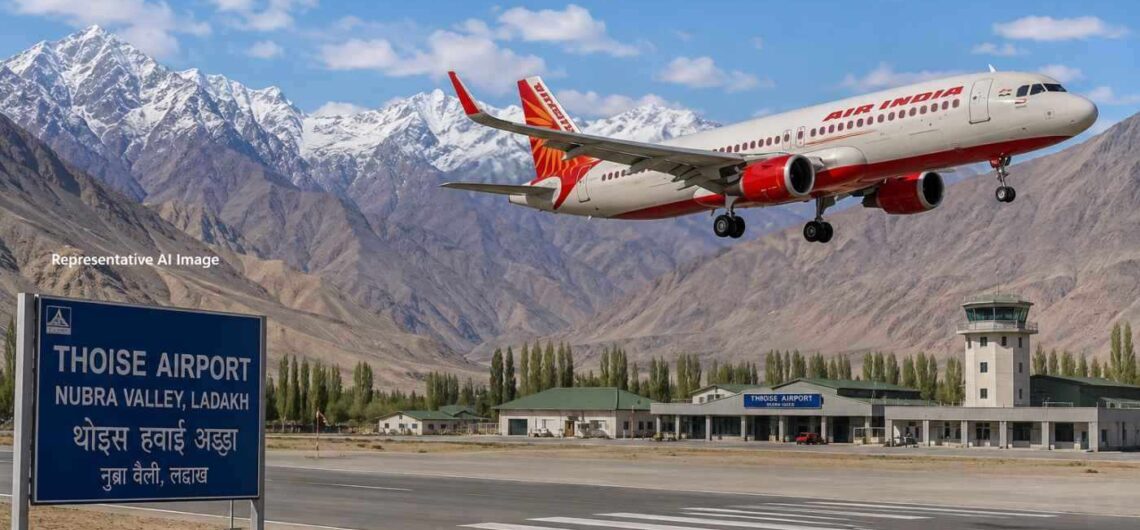
Ladakh has long been one of India’s most fascinating high-altitude travel destinations. Its dramatic mountains, high passes, monasteries, lakes, remote villages, cold deserts and unique culture attract travellers from across India and around the world. However, despite its popularity, reaching many parts of Ladakh remains challenging because of the region’s difficult terrain and dependence on a limited number of transport routes.
For years, Leh Airport has been the primary commercial aviation gateway to Ladakh. Now, the possibility of opening two more airports for civilian and commercial operations could bring a major change to the way tourists explore the Union Territory.
According to a recent post by Ladakh Lieutenant Governor Vinai Kumar Saxena, a high-level meeting was held at Ladakh Bhawan in New Delhi to review preparations for commencing civil operations at Thoise Airport in Nubra Valley and Kargil Airport. The meeting involved senior officials from the Ministry of Defence, Ministry of Civil Aviation, Indian Air Force, Airports Authority of India and the UT Ladakh Administration. The LG stated that the initiative is aimed at improving regional connectivity and unlocking the tourism potential of areas such as Turtuk, Siachen Base Camp, Kargil and Drass.
This development could become one of the most important changes in Ladakh’s tourism infrastructure in recent years.
Chaired a comprehensive review meeting at Ladakh Bhawan Delhi with senior officials of the Ministry of Defence, Ministry of Civil Aviation, IAF, AAI for commencing civil operation at Thoise airport in Nubra Valley and Kargil airport, to boost regional connectivity and tourism in…
— LG Ladakh (@lg_ladakh) August 22, 2026
Thoise Airport in Nubra Valley Could Transform Ladakh Tourism
Among the two proposed aviation gateways, Thoise Airport in Nubra Valley could have a particularly significant impact on tourism.
Nubra Valley is already among the most popular destinations in Ladakh. Places such as Hunder, Diskit, Turtuk, Sumur, Panamik and the Siachen region attract tourists looking for landscapes and experiences that are very different from those around Leh.
At present, most tourists travelling to Nubra first arrive at Leh and then undertake a road journey across the high-altitude Khardung La region. The road journey itself is spectacular, but it also adds considerable travel time to an itinerary.
The proposed civilian operation at Thoise could change this pattern.
The Ladakh Administration has said that the Indian Air Force has approved five acres of land for construction of a new civil terminal at Thoise. Runway recarpeting is underway, with completion targeted for November 2026, while authorities are targeting the commencement of civil operations from an existing refurbished chartered-flight terminal by December 2026.
This does not mean that commercial flights are guaranteed on a particular date; the final launch will depend on infrastructure, regulatory, operational and other required clearances. Nevertheless, the progress represents a major step towards giving Nubra its own air gateway.
Most Popular Ladakh Tours


6 Nights 7 Days Leh Ladakh Tour Package

Complete Ladakh with Hanle and Siachen (10 nights 11 days)

Kashmir and Ladakh Sightseeing Package - 10 Nights 11 Days

Leh Ladakh Tour Package with Hanle and Umling la pass (8 days)

Leh Ladakh Package for 9 Nights and 10 Days

Leh Ladakh Winter Tour Package for 5 Nights 6 Days

Leh Ladakh Luxury Tour Package (6 Nights 7 Days)


Leh Ladakh Winter Tour Package (6 Nights 7 Days)

Delhi - Manali - Leh Ladakh - Srinagar Jeep Safari (Road Trip)

Ladakh Package for 8 Nights and 9 Days


Manali-Shinkula pass- Gonbo Rangjon Tour Package from Delhi

Ladakh Package for 10 Nights and 11 Days
Delhi Manali Ladakh Package for 8 Nights and 9 Days

Srinagar Ladakh Manali Delhi Jeep Safari (10 Nights 11 Days)

Ladakh Package for 3 nights and 4 days


Delhi Manali Leh Srinagar Delhi Jeep Safari - 15 Days

Zanskar Valley with Leh Ladakh Tour Package for 11 Days

Zanskar Valley Tour Package from Delhi (7 Nights 8 Days)

Ladakh Package for 4 Nights and 5 Days with Nubra and Pangong

Ladakh Package for 4 Nights and 5 Days

Jammu - Srinagar -Ladakh -Manali -Delhi Jeep Safari

Ladakh Package for 7 Nights and 8 Days
Srinagar Leh Ladakh Manali Delhi Jeep Safari (11 Days)
Srinagar Ladakh Srinagar Package for 8 Nights 9 Days


Srinagar Leh Ladakh Srinagar Package for 8 Nights 9 Days

Delhi Manali Ladakh Manali Delhi Jeep Safari Package

Zanskar Valley Tour Package with Phugtal Monastery

Leh Ladakh Tour Package from Jammu for 8 nights 9 days

Srinagar - Ladakh - Srinagar Jeep Safari (Road Trip)

Leh Ladakh Tour Package from Manali (11 Nights 12 Days)

Leh Tour Package for 5 Nights 6 Days

6 nights 7 days Leh Ladakh Tour Package with Tso Moriri

Kargil Tour Package with Nubra and Pangong Lake

Zanskar Valley Tour Package from Manali (with Leh Ladakh)

Leh Manali Delhi Jeep Safari | Leh to Manali by Road

Nubra Valley and Pangong Lake Tour Package (5 Nights 6 Days)

Amritsar Manali Leh Bike Tour


Complete Leh Ladakh Tour Package from Srinagar

Srinagar - Ladakh Jeep Safari/Road trip - 8 Days

Pangong Lake Tour Package in Leh Ladakh


Manali Ladakh Manali Road Trip Package

Manali Leh Bike Tour (7 Days)

Manali Leh Ladakh Manali Bike Tour (12 Days)

Leh Srinagar Road Trip Package

5 Star Luxury Hotel Leh Ladakh Tour Package (5 Nights 6 Days)

2 nights 3 days leh ladakh tour package

Ladakh Tour Package with Mig La Pass (8 Nights 9 Days)

Delhi-Manali- Leh Ladakh -Zanskar- Delhi Tour Package by Road


Complete Zanskar Valley Tour Package from Leh (8 Nights 9 Days)

Budget Leh Ladakh Tour Package (5 Nights 6 Days)

4 Nights 5 Days Leh Ladakh Winter Tour Package

Ladakh with Kashmir Sightseeing Tour Package (11N 12D)

Leh Ladakh Photography Tour Package for 8 Nights 9 Days

7 Nights 8 Days Leh Ladakh Winter Tour Package
Why Direct Flights to Nubra Could Be a Game Changer
The biggest advantage of Thoise Airport would be direct accessibility to Nubra Valley.
A traveller who wants to visit Nubra currently has to include a road journey from Leh. With civilian flights to Thoise, suitable air services could allow visitors to reach the region much more directly.
This could have several benefits.
1. More Tourists Could Visit Nubra Valley
Improved accessibility generally makes a destination more attractive to travellers.
Some visitors have limited holidays and may hesitate to include remote destinations if reaching them requires long road journeys. A direct flight option could make Nubra more accessible to senior travellers, families and visitors with limited time.
It could also encourage travellers to design Nubra-focused Ladakh tour packages, rather than treating Nubra merely as one stop in a larger Leh itinerary.
The idea of using Thoise as a tourism gateway is not entirely new. Ladakh’s tourism vision has previously identified the potential of Thoise Airport, noting that it could provide easier access to Nubra and enable tourists to reach places such as Hunder more efficiently.
2. Turtuk Tourism Could Receive a Major Boost
Turtuk is one of the most culturally distinctive destinations in Ladakh. Located close to the Line of Control, the village offers visitors a different cultural and geographical experience from central Ladakh.
Its location, however, also means that accessibility plays an important role in tourism.
If Thoise becomes a functioning civilian airport, it could act as a convenient gateway for tourists travelling towards Turtuk. This could increase demand for homestays, hotels, local guides, taxis, restaurants, handicrafts and other tourism-related services.
The Lieutenant Governor has specifically highlighted Turtuk among the border destinations whose tourism potential could be unlocked through the proposed flight operations.
3. More Opportunities for Local Tourism Businesses
Airport connectivity does not benefit only tourists. It can create opportunities throughout the local economy.
An increase in visitors can generate demand for:
- Hotels and guesthouses
- Homestays
- Local taxis
- Restaurants and cafés
- Tour guides
- Motorcycle and vehicle services
- Adventure tourism operators
- Local handicrafts
- Cultural experiences
- Village tourism
- Local food and traditional products
For remote communities, tourism can become an important source of income when it is developed responsibly.
This is particularly important for Nubra, where tourism has already become an important economic activity. Better connectivity could allow tourism benefits to spread to villages beyond the most frequently visited destinations.
Kargil Airport Could Create Another Tourism Gateway
The second proposed airport is Kargil Airport.
While Thoise is particularly important for Nubra Valley, civilian aviation at Kargil could create a new western gateway to Ladakh.
The authorities have scheduled a joint inspection involving the Indian Air Force, Airports Authority of India and Ministry of Civil Aviation to assess Kargil Airport’s readiness for civil operations.
Kargil is already an important destination for travellers travelling between Kashmir and Ladakh. It also provides access to places such as Drass, Suru Valley and the wider Kargil region.
Improved air connectivity could therefore encourage travellers to create Kargil-to-Leh, Kargil-to-Zanskar and other multi-region itineraries instead of following the traditional Leh-centric travel pattern.
The Lieutenant Governor has also identified Kargil and Drass among the areas that could benefit from the expansion of air connectivity.
Popular Leh Ladakh Tour Packages
5 Star Luxury Hotel Leh Ladakh Tour Package (5 Nights 6 Days)
Delhi – Manali – Leh Ladakh – Srinagar Jeep Safari (Road Trip)
Ladakh Package for 4 Nights and 5 Days with Nubra and Pangong
Leh Ladakh Tour Package with Hanle and Umling la pass (8 days)
From One Tourism Gateway to a Multi-Gateway Ladakh
Perhaps the biggest long-term benefit of the proposed airports is that Ladakh could gradually move away from a single-gateway tourism model.
At present, Leh dominates the commercial aviation network. This means that a very large proportion of tourists arriving by air first enter Ladakh through Leh and then travel onward by road.
With commercial aviation potentially expanding to Leh, Thoise and Kargil, tourists could enter and leave Ladakh through different gateways.
Imagine a traveller arriving at Thoise, exploring Nubra and Turtuk, travelling overland towards Pangong Lake and Leh, and finally departing from Leh.
Another traveller could arrive at Kargil, explore Drass and Suru Valley, continue towards Zanskar and then travel to Leh.
Such possibilities could encourage tour operators to develop more diverse Leh Ladakh tour packages, including one-way routes and multi-gateway itineraries.
The New Airports Could Help Promote Offbeat Ladakh
One of the biggest challenges in Ladakh tourism is that popular destinations can experience heavy tourist pressure during the peak season.
Leh, Pangong Lake, Nubra and some of the better-known attractions receive large numbers of visitors.
Better connectivity to other regions could help distribute tourism geographically.
Instead of every traveller following the same Leh–Nubra–Pangong route, visitors could be encouraged to explore Kargil, Drass, Turtuk, Suru Valley, Zanskar and other emerging destinations.
This could help create a more balanced tourism economy.
However, connectivity should not mean uncontrolled tourism.
Connectivity Must Go Together with Sustainable Tourism
Ladakh is an extremely fragile high-altitude environment. Its cold desert ecosystem, limited water resources, wildlife habitats and traditional communities need careful protection.
The opening of additional airports should therefore be viewed as an opportunity to promote responsible and sustainable tourism, not simply to increase visitor numbers.
Tourism planners should focus on carrying capacity, waste management, water conservation, responsible driving, protection of wildlife and respect for local culture.
Greater accessibility should never become an excuse for illegal off-roading, littering, disturbance of wildlife or unplanned construction.
A successful tourism model for Nubra and Kargil should ensure that local communities benefit while the natural environment remains protected.
Affordable Airfare Will Be Important
Another important issue is the affordability of air travel.
Improved connectivity is meaningful only when flights are reasonably accessible to both residents and tourists. High airfares can discourage travellers and limit the practical benefits of new routes.
Interestingly, the Ladakh Administration had already raised concerns about high airfares while advocating better air connectivity, including discussions around services from Thoise and Kargil under the Regional Connectivity Scheme.
Therefore, the success of the new airports will depend not only on infrastructure but also on airline participation, flight frequency, aircraft availability, fares and reliable operations.
Winter Tourism Could Also Benefit
One of the most exciting possibilities is the development of winter tourism in Ladakh.
Road conditions in the high Himalayas can be affected by snowfall, extreme weather and seasonal closures. Better air connectivity can provide an additional transport option for residents and visitors.
The Ladakh Administration has also discussed exploring flights to Nubra under the Regional Connectivity Scheme, including the possibility of connecting Nubra with other destinations during the winter season.
If reliable winter flights become available, Nubra could potentially develop as a stronger year-round destination.
This could create new opportunities for winter homestays, cultural tourism, photography, snow experiences and local businesses.
A New Era for Ladakh Tour Packages
The development of Thoise and Kargil airports could also change how travel companies design Ladakh holidays.
Instead of offering only traditional round-trip itineraries from Leh, tour operators could introduce more flexible routes such as:
Thoise (Nubra) – Turtuk – Pangong – Leh
Kargil – Drass – Suru Valley – Zanskar – Leh
Leh – Nubra – Turtuk – Thoise
Thoise – Nubra – Pangong – Leh – Kargil
Thoise (Nubra) – Pangong – Hanle – Tso Moriri – Leh
Such routes could make a Ladakh holiday more diverse while reducing unnecessary backtracking.
For travellers searching online for Leh Ladakh tour packages, the availability of multiple airports could eventually provide more choices in terms of arrival point, departure point and duration.
Ladakh Could Become More Than Just Leh
Leh will remain the heart of Ladakh tourism. The town has the region’s major hotels, monasteries, markets, restaurants, travel services and the primary commercial airport.
The objective of additional airports should not be to reduce the importance of Leh.
Instead, they can complement Leh by creating a network of tourism gateways.
Leh can remain the central hub, Thoise can become the gateway to Nubra and the northern border region, while Kargil can strengthen access to western Ladakh and the Zanskar–Drass region.
This could create a much more diverse tourism map for the Union Territory.
A Promising Development for the Future of Ladakh Tourism
The proposed expansion of commercial aviation to Thoise and Kargil represents much more than an infrastructure project. It has the potential to reshape Ladakh’s tourism geography.
For Nubra Valley in particular, the planned civilian operations from Thoise could be transformative. Direct or more convenient air access could make destinations such as Hunder, Diskit and Turtuk easier to include in travel plans while creating new opportunities for local communities.
At the same time, Kargil Airport could provide another important gateway to western Ladakh and help promote destinations such as Kargil and Drass.
The Lieutenant Governor’s recent review has given fresh momentum to this vision. With five acres approved for a new civil terminal at Thoise, runway work underway and a target for civil operations in December 2026, Nubra is moving closer to becoming a new aviation gateway to Ladakh.
The real success, however, will be measured not simply by the number of flights operating from these airports, but by whether the new connectivity creates affordable, reliable, inclusive and environmentally responsible tourism.
If planned carefully, two additional commercial aviation gateways could help Ladakh move from a Leh-centric tourism model towards a broader regional tourism network—one that opens the doors to remote valleys, supports local communities and gives travellers more ways to discover the extraordinary diversity of this Himalayan Union Territory.
Better Future
The future of Ladakh tourism could be increasingly connected through multiple gateways. Nubra Valley (Thoise) Airport has the potential to put Nubra Valley much closer to travellers from across India, while Kargil Airport could strengthen the tourism economy of western Ladakh.
For visitors planning a Leh Ladakh trip, this could eventually mean shorter travel times, new itineraries and the opportunity to explore places that have remained relatively remote.
But Ladakh’s greatest attraction is its pristine landscape and unique culture. Therefore, as connectivity improves, protecting what makes Ladakh special must remain at the heart of tourism planning.
Better connectivity should bring more people to Ladakh—but responsible tourism should ensure that Ladakh remains beautiful for generations to come.

Comments