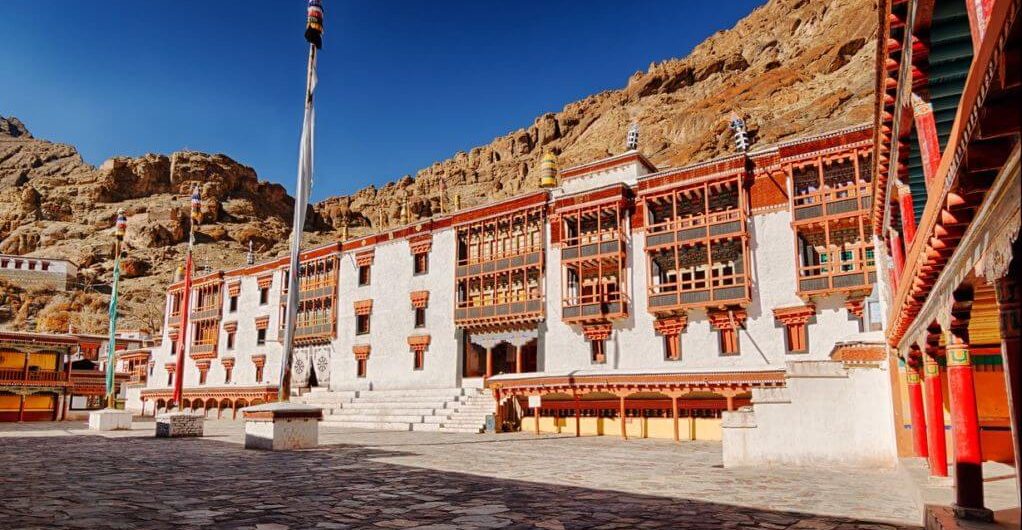
Hemis monastery (gompa) is a Buddhist monastery of Drukpa lineage of Buddhism and is located in Hemis village of Ladakh, about 45 km from Leh. The monastery was built before 11th century but it was re-established in 1672 by the king of Ladakh Sengge Namgyal.
An annual Hemis Festival, in honour of Padmasambhava, is observed here in the month of June. Naropa, pupil of yogi Tilopa and teacher of translator Marpa is connected with this monastery. A translation was made by A Grunwedel of Naropa’s biography which was found in Hemis monastery.
According to a legend, and Russian journalist Nicolas Notovitch (1894), the Jesus had travelled to the Hemis monastery during his “Lost Years”, but this is debatable.
Large numbers of tourists visit Hemis every year. The Hemis Festival is dedicated to Lord Padmasambhava venerated as the dance performance at Hemis Monastery representing the reincarnation of Buddha. He is believed to have been born on the 10th day of the fifth month of the Monkey year as predicted by the Buddha Shakyamuni.
It is also believed that his life mission was, and remains, to improve the spiritual condition of all living beings. And so on this day, which comes once in a cycle of 12 years, Hemis observes a major extravaganza in his memory. Hemis monastery has a large library that houses ancient religious texts, few of them in unknown languages.
Some evidence suggests that the monastery existed even before 11 th century. Naropa is considered the founding father of the Kagyu-lineage of the Himalayan esoteric Buddhism. Hence Hemis is the main seat of the Kagyu lineage of Buddhism.
Be it Indian or Foreigner tourists, all throng the Hemis Monastery during their Ladakh visit. Some plans their dedicated visit to Hemis gompa along with Thiksey monastery, but most of the tourists visit Hemis and Thiksey while going or returning from Pangong Lake. The Thiksey monastery is located on the Leh-Pangong (Leh-Manali) highway, but you need to take a link road from the highway to reach Hemis Gompa.
Most Popular Ladakh Tours


6 Nights 7 Days Leh Ladakh Tour Package

Complete Ladakh with Hanle and Siachen (10 nights 11 days)

Kashmir and Ladakh Sightseeing Package - 10 Nights 11 Days

Leh Ladakh Tour Package with Hanle and Umling la pass (8 days)

Leh Ladakh Package for 9 Nights and 10 Days

Leh Ladakh Winter Tour Package for 5 Nights 6 Days

Leh Ladakh Luxury Tour Package (6 Nights 7 Days)


Leh Ladakh Winter Tour Package (6 Nights 7 Days)

Delhi - Manali - Leh Ladakh - Srinagar Jeep Safari (Road Trip)

Ladakh Package for 8 Nights and 9 Days


Manali-Shinkula pass- Gonbo Rangjon Tour Package from Delhi

Ladakh Package for 10 Nights and 11 Days
Delhi Manali Ladakh Package for 8 Nights and 9 Days

Srinagar Ladakh Manali Delhi Jeep Safari (10 Nights 11 Days)

Ladakh Package for 3 nights and 4 days


Delhi Manali Leh Srinagar Delhi Jeep Safari - 15 Days

Zanskar Valley with Leh Ladakh Tour Package for 11 Days

Zanskar Valley Tour Package from Delhi (7 Nights 8 Days)

Ladakh Package for 4 Nights and 5 Days with Nubra and Pangong

Ladakh Package for 4 Nights and 5 Days

Jammu - Srinagar -Ladakh -Manali -Delhi Jeep Safari

Ladakh Package for 7 Nights and 8 Days
Srinagar Leh Ladakh Manali Delhi Jeep Safari (11 Days)
Srinagar Ladakh Srinagar Package for 8 Nights 9 Days


Srinagar Leh Ladakh Srinagar Package for 8 Nights 9 Days

Delhi Manali Ladakh Manali Delhi Jeep Safari Package

Zanskar Valley Tour Package with Phugtal Monastery

Leh Ladakh Tour Package from Jammu for 8 nights 9 days

Srinagar - Ladakh - Srinagar Jeep Safari (Road Trip)

Leh Ladakh Tour Package from Manali (11 Nights 12 Days)

Leh Tour Package for 5 Nights 6 Days

6 nights 7 days Leh Ladakh Tour Package with Tso Moriri

Kargil Tour Package with Nubra and Pangong Lake

Zanskar Valley Tour Package from Manali (with Leh Ladakh)

Leh Manali Delhi Jeep Safari | Leh to Manali by Road

Nubra Valley and Pangong Lake Tour Package (5 Nights 6 Days)

Amritsar Manali Leh Bike Tour


Complete Leh Ladakh Tour Package from Srinagar

Srinagar - Ladakh Jeep Safari/Road trip - 8 Days

Pangong Lake Tour Package in Leh Ladakh


Manali Ladakh Manali Road Trip Package

Manali Leh Bike Tour (7 Days)

Manali Leh Ladakh Manali Bike Tour (12 Days)

Leh Srinagar Road Trip Package

5 Star Luxury Hotel Leh Ladakh Tour Package (5 Nights 6 Days)

2 nights 3 days leh ladakh tour package

Ladakh Tour Package with Mig La Pass (8 Nights 9 Days)

Delhi-Manali- Leh Ladakh -Zanskar- Delhi Tour Package by Road


Complete Zanskar Valley Tour Package from Leh (8 Nights 9 Days)

Budget Leh Ladakh Tour Package (5 Nights 6 Days)

4 Nights 5 Days Leh Ladakh Winter Tour Package

Ladakh with Kashmir Sightseeing Tour Package (11N 12D)

Leh Ladakh Photography Tour Package for 8 Nights 9 Days

7 Nights 8 Days Leh Ladakh Winter Tour Package
Hemis Monastery, Leh Ladakh – A Spiritual & Cultural Gem
Nestled amidst the rugged mountains of Ladakh, Hemis Monastery (Hemis Gompa) is one of the largest and wealthiest monasteries in the region. Located about 45 km from Leh town, in the serene Hemis village, this ancient monastery is not only a spiritual center but also a vibrant cultural hub that attracts thousands of tourists from across the world every year.
History and Significance of Hemis Gompa
Hemis Monastery belongs to the Drukpa lineage of Tibetan Buddhism and holds immense religious significance in Ladakh. While historical evidence suggests that the monastery existed before the 11th century, it was re-established in 1672 by King Sengge Namgyal, one of the most powerful rulers of Ladakh.
The monastery is closely connected with Naropa, the pupil of the great yogi Tilopa and teacher of Marpa, who later taught the famous Tibetan saint Milarepa. Naropa is considered the founding father of the Kagyu lineage of Himalayan esoteric Buddhism, making Hemis the principal seat of the Kagyu tradition in Ladakh.
The Hemis Festival – A Celebration of Padmasambhava
The most famous attraction of Hemis Monastery is the annual Hemis Festival, celebrated every year in June or July, depending on the Tibetan lunar calendar. This vibrant festival is dedicated to Guru Padmasambhava (Guru Rinpoche), who is revered as the reincarnation of Buddha Shakyamuni and is believed to have been born on the 10th day of the fifth month of the Monkey year.
During the festival, monks perform the Cham Dance (masked dance) in the courtyard of the monastery. The colorful costumes, elaborate masks, and rhythmic music of cymbals, drums, and long horns create a mesmerizing spiritual atmosphere. The dance symbolizes the triumph of good over evil and draws huge crowds of Indian and international tourists.
Every 12 years, Hemis Monastery hosts a grand extravaganza known as the Naropa Festival, when the sacred relics and rare treasures of the monastery are displayed to the public.
Architecture and Treasures of Hemis Monastery
The monastery complex is a true architectural wonder, adorned with stunning frescoes, intricate woodwork, and vibrant wall paintings depicting Buddhist deities. Hemis houses a large library with ancient manuscripts and religious texts, some of which are preserved in languages that are no longer known.
The monastery also treasures a huge Thangka (sacred painting) of Lord Padmasambhava, which is unfurled only during the festival held once in 12 years.
Legends and Mysteries of Hemis Monastery
Hemis Monastery is also associated with fascinating legends. According to the Russian journalist Nicolas Notovitch (1894), Hemis preserved manuscripts suggesting that Jesus Christ visited the monastery during his “Lost Years”—the period of his life not recorded in the Bible. Although this claim remains debated, it continues to intrigue spiritual seekers and historians alike.
Popular Leh Ladakh Tour Packages
5 Star Luxury Hotel Leh Ladakh Tour Package (5 Nights 6 Days)
Delhi – Manali – Leh Ladakh – Srinagar Jeep Safari (Road Trip)
Ladakh Package for 4 Nights and 5 Days with Nubra and Pangong
Leh Ladakh Tour Package with Hanle and Umling la pass (8 days)
Hemis Monastery and Naropa
The monastery’s spiritual connection with Naropa makes it one of the most revered Buddhist institutions in the Himalayan region. Naropa’s biography was discovered here, later translated by A. Grünwedel. His teachings laid the foundation for the Kagyu lineage, which continues to flourish through Hemis.
Hemis Monastery in a Ladakh Itinerary
For travelers exploring Ladakh, a visit to Hemis Monastery is a must. Many tourists combine a visit to Hemis and Thiksey Monastery during their journey towards Pangong Lake or on the return. While Thiksey Monastery lies directly on the Leh–Manali / Leh–Pangong highway, Hemis requires a short detour from the main road, but the visit is well worth it.
Why Visit Hemis Monastery?
-
To witness the Hemis Festival, one of Ladakh’s biggest cultural celebrations.
-
To explore the ancient Buddhist library and relics preserved for centuries.
-
To admire the architecture, wall paintings, and sacred thangkas.
-
To experience the spiritual aura of Drukpa Buddhism.
-
To learn about fascinating legends, including the stories of Naropa and Jesus in Hemis.
Best Time to Visit Hemis Monastery
-
May to October is the best time, with pleasant weather and clear roads.
-
June/July (festival time) is the most vibrant, but also crowded.
-
In winter, the monastery can be visited, but the region experiences extreme cold.
Travel Tips for Hemis Monastery
-
Carry some warm clothes even in summer, as Hemis is at high altitude.
-
Respect the monastery rules—silence and photography restrictions in certain areas.
-
Plan your trip during the Hemis Festival for a truly unforgettable cultural experience.
-
Hire a local guide to understand the rich history and legends of Hemis.
Hemis Monastery in Leh Ladakh is more than just a religious site—it is a living cultural treasure that preserves centuries of Buddhist wisdom, traditions, and festivals. Whether you are a history enthusiast, a spiritual seeker, or simply a curious traveler, Hemis offers an experience that is deeply enriching and unforgettable.
No trip to Ladakh is complete without visiting Hemis Gompa, where spirituality meets vibrant culture amidst the breathtaking Himalayan landscape.

Comments